
About Mandya Town

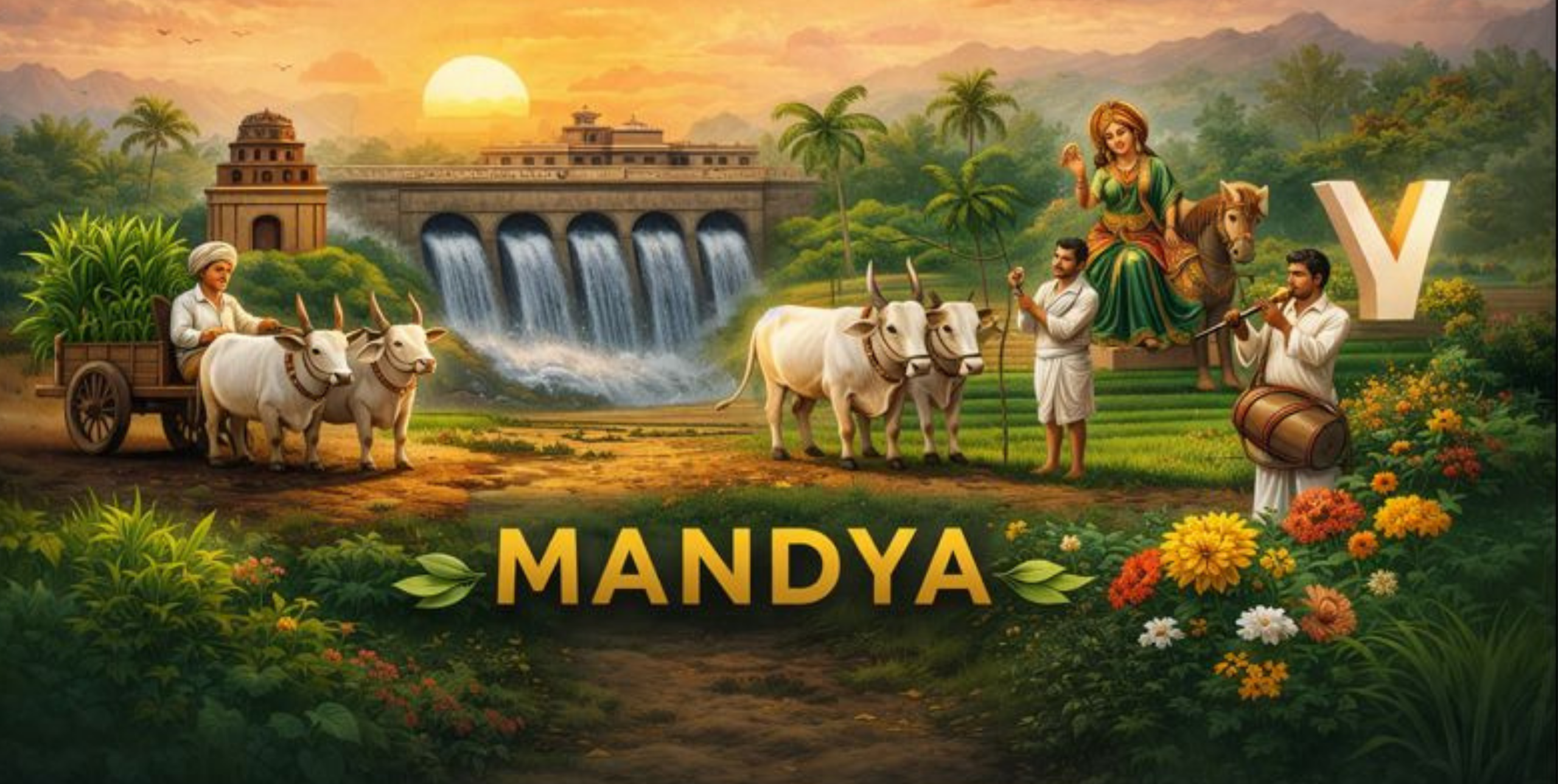
Mandya Town is a historic town located in the southern Indian state of Karnataka, known for its fertile agricultural lands, cultural heritage, and dynamic community life. Officially referred to as the “Sugar Bowl of Karnataka,” Mandya is deeply influenced by its long tradition of sugarcane farming, local festivals, and the fertile plains created by the Kaveri River. The town serves as an important regional hub for trade, education, agriculture, and community services, connecting nearby villages and rural communities with larger economic centers. Mandya reflects a balanced blend of tradition and modernity, where agricultural roots coexist harmoniously with steady infrastructural growth and cultural vibrancy.
HISTORY & HERITAGE
Ancient
Origin Of Name
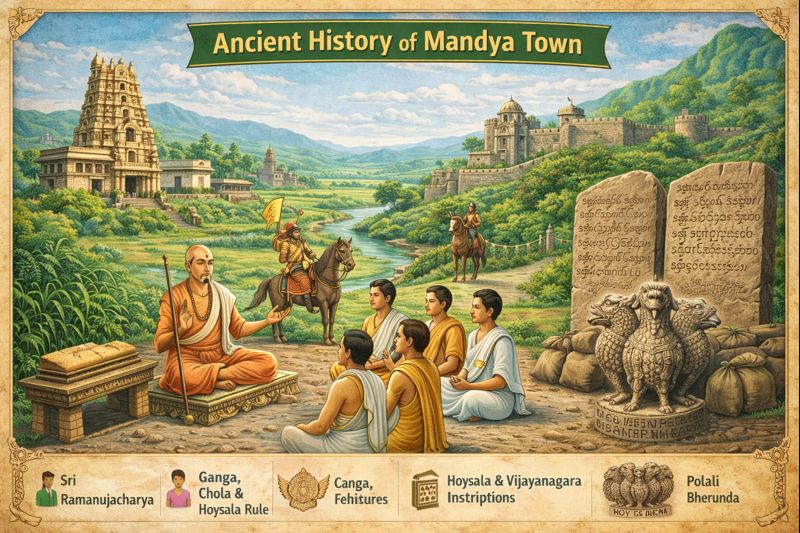
Mandya district is part of large plateau from Mysore to the edges of Easter Ghats. Therefore, there are not many legends describing the origin of the district as such, but there are quite a few legends describing the origin of the place.
Mandya seems to have been known as ‘Vedaranya’ and later, as ‘Vishnupura’ in Kritayuga. It is said that a rishi (sage) was doing a penance here and installed an image of God Janardana and was said to be teaching wild beast to pronounce the sacred word, VEDA. On this account, the place came to be known as ‘Vedaranya’.
Several years later, but during the same yuga, another rishi, who was residing here, setup an image of the God Sakaleshwara swami and Lord Vishnu, it is said, appeared to him. The place was thereafter renamed as ‘Vishnupura’. Another account says that towards the age of Dwapara yuga, king by name Indravarma, who had not issues, came to this place in the hope of getting a son. His prayers were granted, and his son Somavarma built a fort and an agrahara at this place and gave it the name Mandevemu, which, it is believed has been corrupted into Mandya. It is also said that in ancient days, a great and popular sage, called Mandavya, lived in the area doing tapas and the place came to be called Mandya after his name.
HISTORICAL TIMES
Gangas:-
The Gangas ruled the central and southern parts of the old Mysore State, including the Mandya District and parts of the Cauvery basin. They ruled from about 2nd Century A.D to about the beginning of the 11th Century A.D. The region ruled over by the Ganga Kings was know as Gangavadi. The Ganga kings who ruled over Gangavadi, numbered about thirty three.
Hoysalas:-
Bittideva(afterwards called Vishnuvardhana) retook Talakad and drove the cholas out of Mysore. His general Ganagaraja, who was a descendent of the old Ganga kings, effected the capture of Talakad. Hoysalas ruled till about 1346, when Hoysala kingdom was annexed by the Vijayanagar rulers.
Vijayanagar Empire:-
Narasaraja, the founder of the Third Dynasty of Vijayanagara, seized Srirangapatna around 1495. In 1610 Raja Wodeyar succeeded in capturing Srirangapatna from Tirumala-II.
The line of Wodeyars who were in power after Raja Wodeyar is as follows :-
- Chamaraja Wodeyar II (1617 – 1637)
- Immadi Raja Wodeyar (1637 – 1638)
- Kanthirava Narsa Raja (1638 – 1659)
- Deva Raja Wodeyar (1659 – 1673)
- Chikka Deva Raja Wodeyar (1673 – 1704)
- Kanthirava Narasaraj Wodeyar II (1704 –1714)
- Krishnaraja Wodeyar I (1714 – 1732)
- Chamaraja Wodeyar VII(1732 – 1734)
- Krishnaraja Wodeyar II (1734 – 1766)
- Nanja Raja – 1766-1770
- Bettada Chamaraja Wodeyer VIII (1776 – 1796)
- Krishnaraja Wodeyer III (1799-1831)
- Nalvadi Krishna Raja Wodeyer (1895-1940)
- Jaya Chamaraja Wodeyer (1940-1959)
medieval period
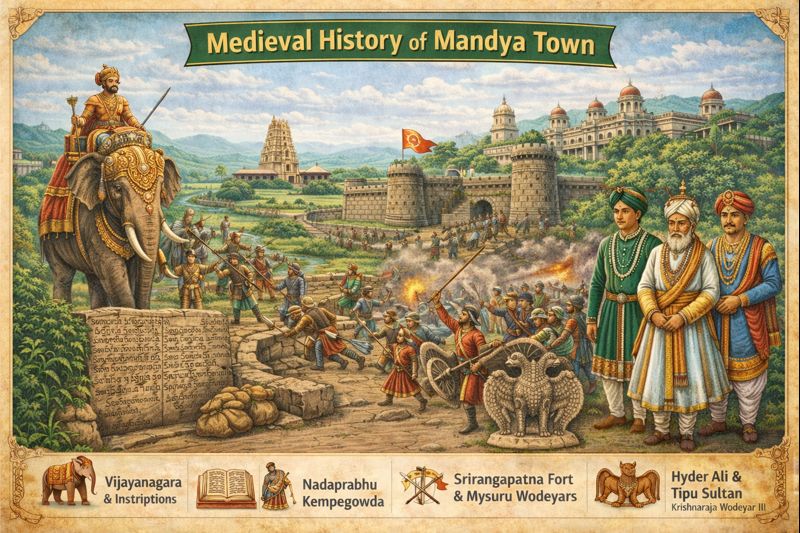
During the medieval era, Mandya gained prominence under the Vijayanagara Empire and later under the Wodeyars of Mysuru. This period saw significant growth in administration, trade, and temple culture. Nearby historic towns like Srirangapatna became important political and military centers, especially during the reign of Tipu Sultan. The medieval period also witnessed improvements in irrigation and land management, which strengthened Mandya’s agricultural economy. Religious institutions and festivals flourished, shaping the cultural identity that continues today.
Modern Period
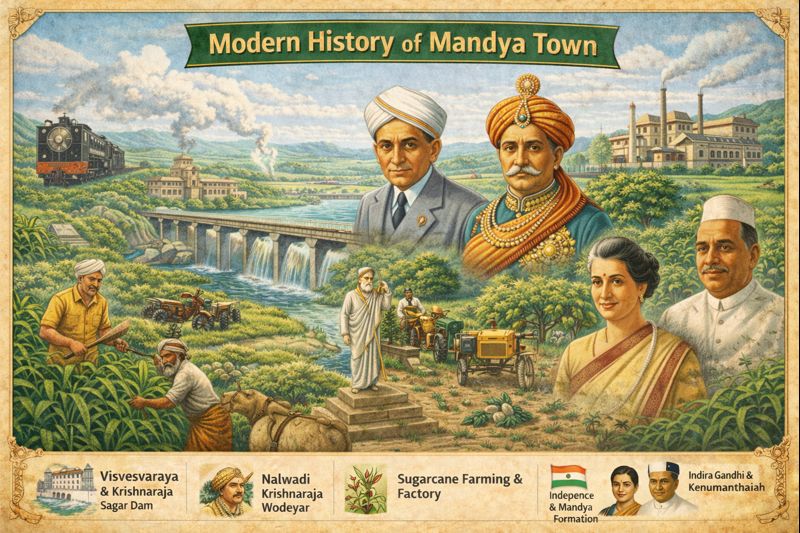
In the modern era, Mandya evolved rapidly with the development of irrigation projects along the Kaveri River, transforming the region into one of Karnataka’s most productive agricultural belts. The establishment of sugar factories and cooperative societies earned Mandya the title “Sugar Bowl of Karnataka.” With the expansion of road and rail networks, educational institutions, healthcare facilities, and administrative offices, Mandya developed into an important district headquarters. Today, Mandya balances tradition with progress, preserving its heritage while embracing modern infrastructure and digital connectivity.
AGRICULTURE – “SUGAR BOWL OF KARNATAKA”
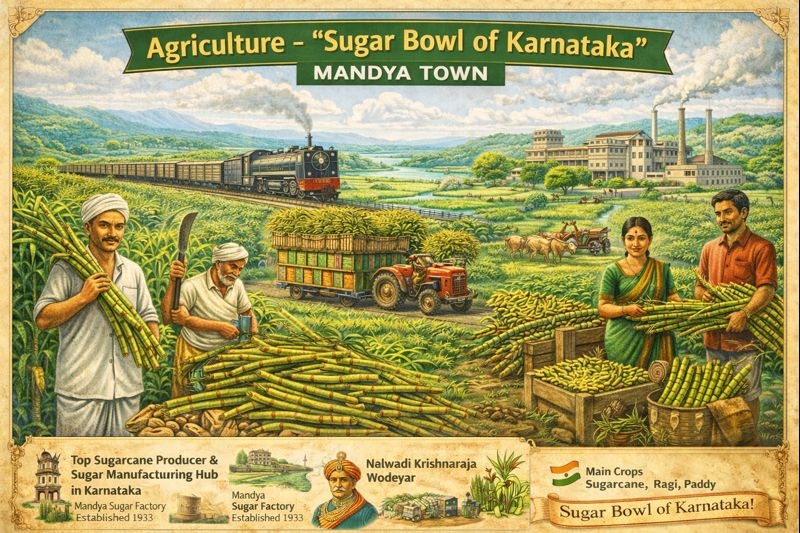
Mandya Town is proudly known as the “Sugar Bowl of Karnataka” due to its extensive sugarcane cultivation and strong agro-based economy. Blessed with fertile alluvial soil and the life-giving waters of the Cauvery River, Mandya has remained one of the most productive agricultural regions in the state.
Sugarcane farming has been the backbone of Mandya’s economy for decades. The introduction of large-scale irrigation projects, especially the Krishnaraja Sagar (KRS) Dam, transformed the region into a thriving agricultural hub. The reliable water supply enabled farmers to grow sugarcane throughout the year, making Mandya a leading contributor to Karnataka’s sugar production. The introduction of large-scale irrigation projects
What Defines Mandya
92%
Agriculture-Driven Economy
Mandya’s economy is largely supported by sugarcane cultivation and allied agricultural activities, earning it the title “Sugar Bowl of Karnataka.”
85%
Cultural & Festival Participation
Residents actively participate in traditional festivals, temple events, and cultural celebrations throughout the year. both town and rural areas.roads
70%
Growth in Infrastructure & Services
Mandya continues to develop with improved roads, education, healthcare, and connectivity supporting both town
Infrastructure and Connectivity
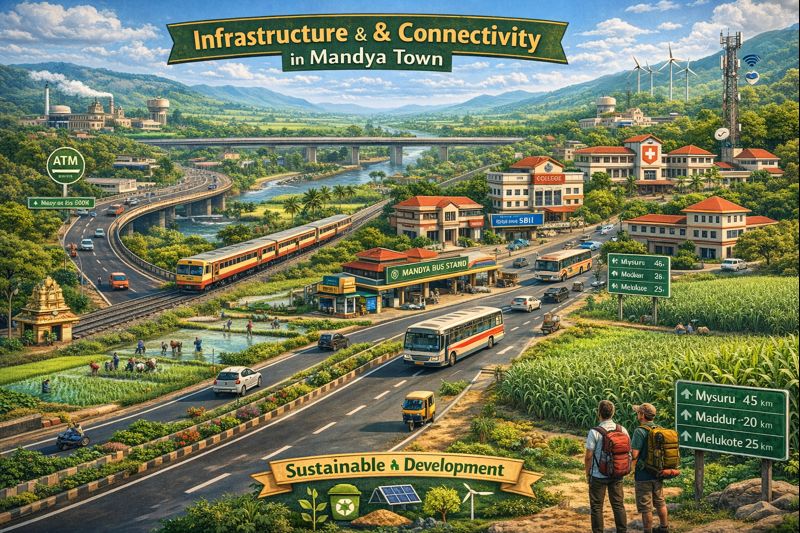
Mandya Town has steadily developed its infrastructure while maintaining a balance between urban growth and agricultural sustainability. The town is well-connected by road and rail, making it an important link between Mysuru and Bengaluru. National and state highways provide smooth access to nearby towns and rural areas, supporting trade, agriculture, and daily commuting.
The Mandya Railway Station serves as a key transit point, connecting the town to major cities across Karnataka and neighboring states. Public transport facilities, including buses and local services, ensure easy movement within the town and surrounding villages.
Culture, Communities, and Traditions
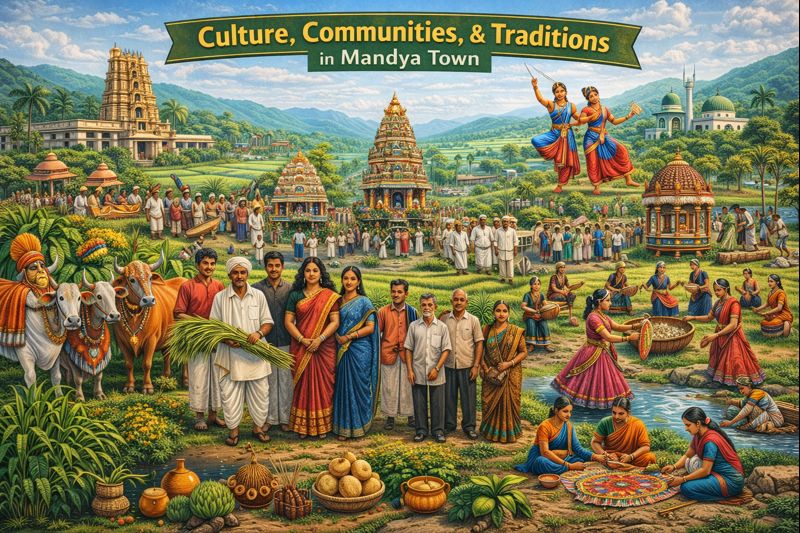
Mandya’s culture is strongly influenced by Kannada traditions and values. The Kannada language, literature, folk arts, and classical music play an important role in everyday life. Traditional art forms such as Dollu Kunitha, Yakshagana, and Bharatanatyam are performed during festivals and cultural events, keeping the heritage alive across generations.
Temples, village streets, and open grounds often become cultural hubs where rituals, music, and performances take place, reflecting the town’s vibrant cultural atmosphere.
Development & Opportunities
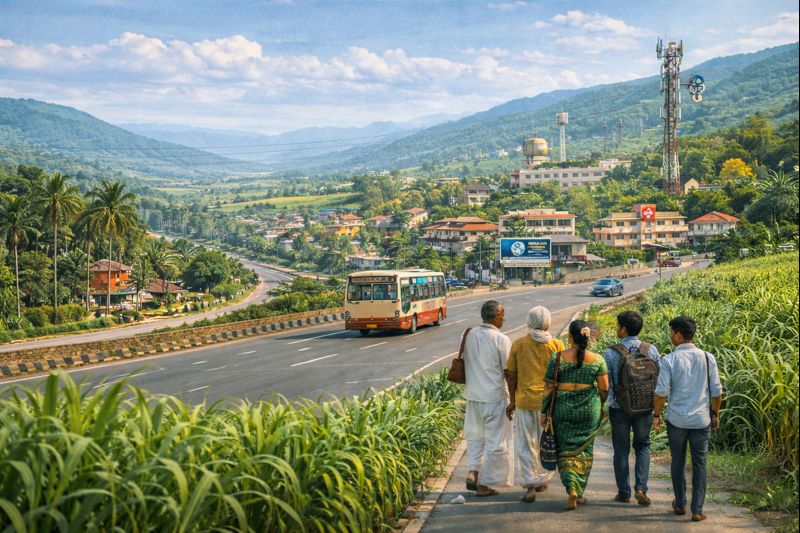
Mandya stands out for its strategic location, agricultural strength, and improving infrastructure. With access to education, healthcare, transport, and digital services, the town continues to grow while preserving its cultural identity.
Mandya Town is a perfect blend of rich culture, strong community values, and steady development. From fertile farmlands and vibrant traditions to growing infrastructure and modern facilities, Mandya offers a balanced lifestyle rooted in heritage and progress. Whether you are a visitor, resident, or investor, Mandya welcomes you with warmth, opportunity, and authenticity.
Mandya Town – A Journey Through Time and Growth
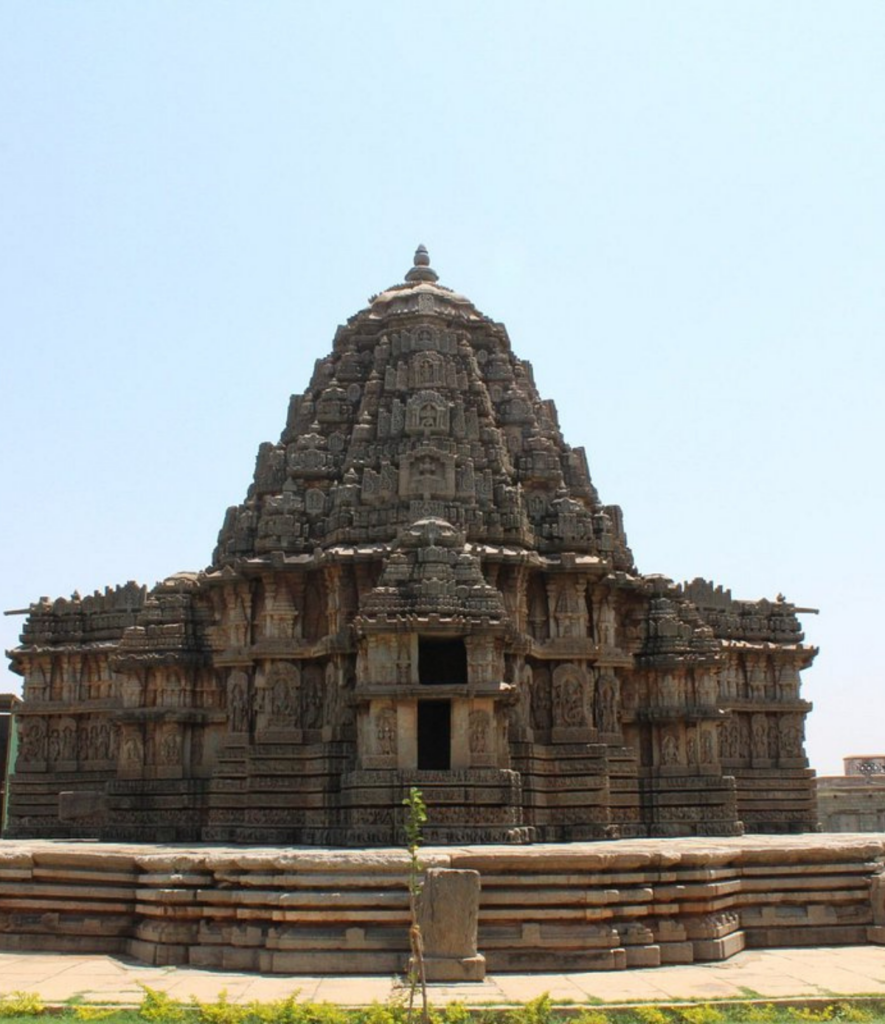
Mandya Town stands as a unique blend of rich heritage, agricultural strength, and modern development. From its ancient roots and cultural traditions to its role as the Sugar Bowl of Karnataka, Mandya reflects resilience, community spirit, and progress. As the town continues to grow, it remains deeply connected to its traditions, natural resources, and people, making it a welcoming place to live, work, and visit.
Mandya Town represents a harmonious integration of history, culture, agriculture, and development. With strong roots in tradition and a clear vision for sustainable growth, the town continues to serve as an important regional center while preserving its cultural and environmental heritage.